HADRIAN AND ANTINOUS / SCENE STUDY
Making attraction believable in Hadrian and Antinous
The characters in this scene are AI generated.
A scene study of gaze, timing and the emotional credibility of generated characters
By Lee J Buckley, Visual Movement
At the writing table, Hadrian’s attention returns to Antinous. Antinous remains close. Toward the end of the shot, a slight change at his mouth makes the exchange feel warmer. For me, this is where the relationship becomes emotionally legible. Attraction begins to register through the attention the characters appear to give each other.
The characters in this scene are AI generated. The question I want to examine is how their interaction acquires credibility on screen. The answer lies in the way looking, posture, duration and setting work together. Each gives the viewer something to interpret, and the sequence gives those details a relationship.
What actually happens in the shot
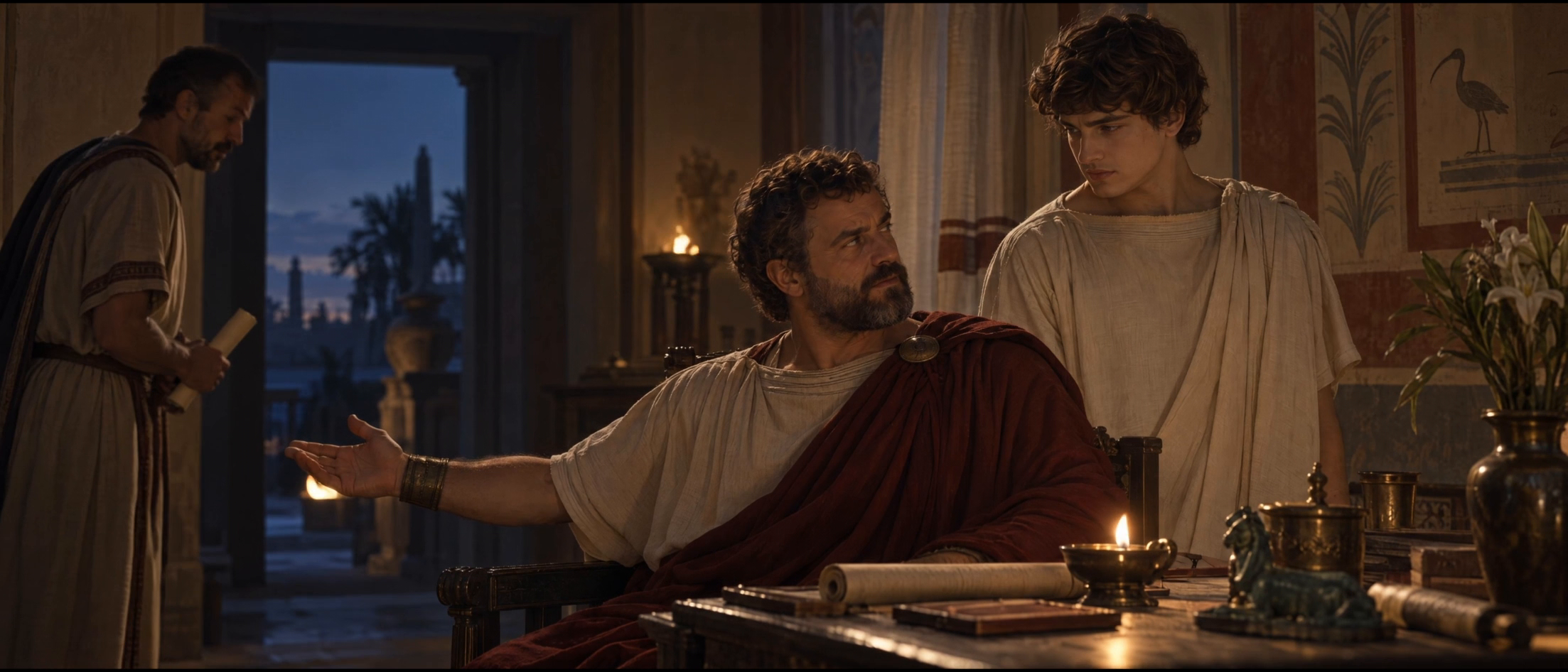
In the 56.5 second teaser, the writing table interaction appears at approximately 00:37.8 to 00:47.7, including its dissolves. Hadrian sits on the left of the image. Antinous stands close beside and slightly behind him on the right. A third figure moves away through the cool blue doorway while the table and faces occupy the warmer interior.
Hadrian is already looking upward toward Antinous when the scene begins. His arm extends outward toward the departing figure. That gesture gradually settles, with the arm lowered toward the chair by about 00:41. His gaze briefly dips, then returns upward by approximately 00:43.
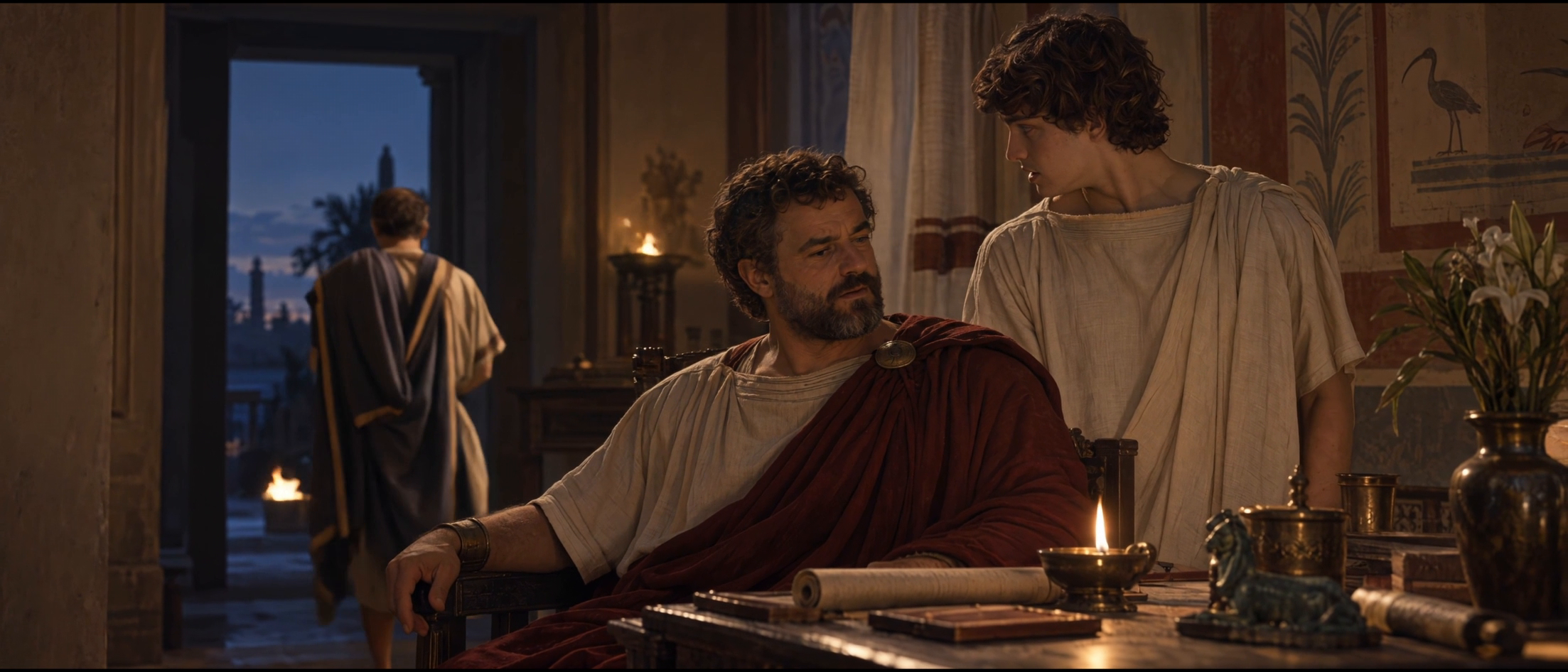
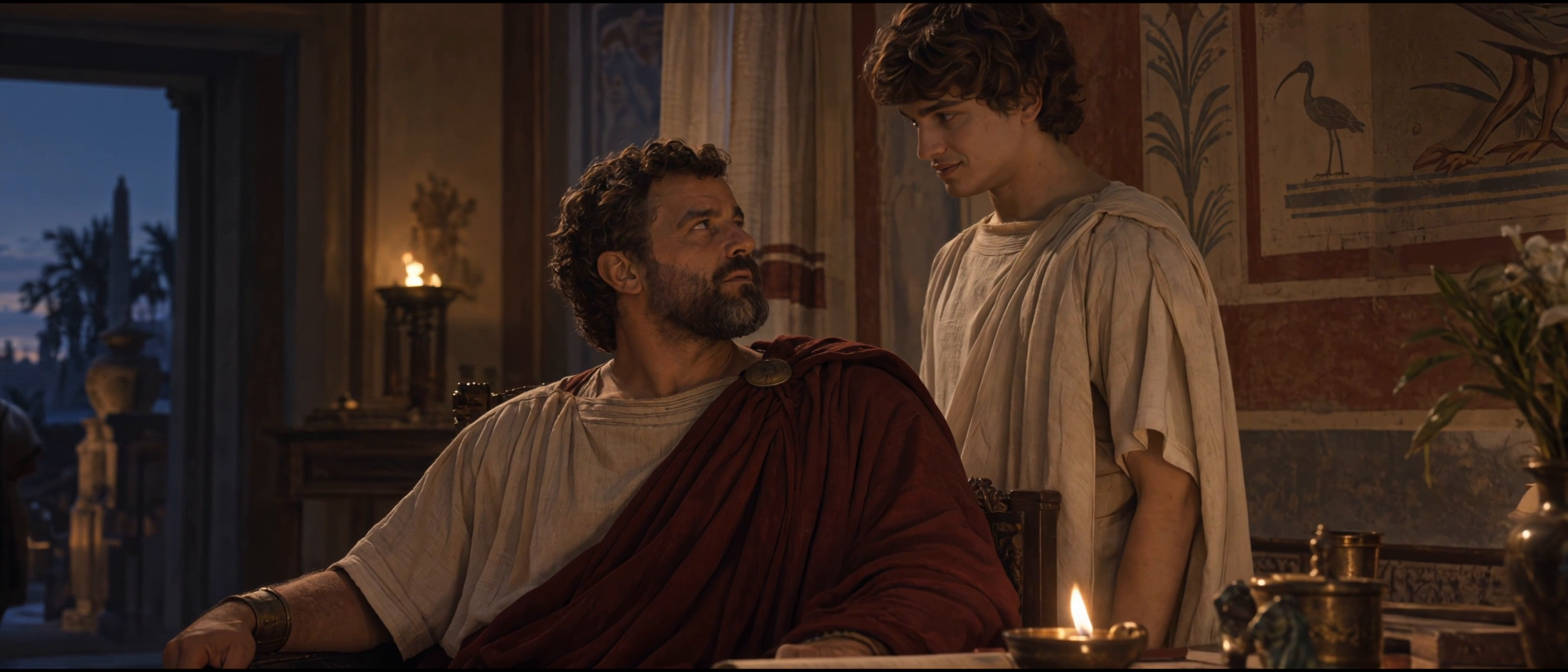
Antinous remains inclined toward him. His attention shifts slightly during the departure before settling downward toward Hadrian. Late in the shot, around 00:46 to 00:47.5, a small lifting at the mouth reads as the beginning of a smile. Both characters remain visible as the composition gradually tightens.
Attention becomes an exchange
A look gains dramatic meaning through what follows it. Here, Hadrian’s upward attention is held against Antinous’s proximity and downward orientation. The brief dip and return create a small progression. I read the later softening of Antinous’s expression as an answer within that progression.
This is the core of the scene’s intimacy for me. Their attention appears responsive. The viewer can follow how one character’s behaviour relates to the other across time, with enough variation to suggest an encounter that is still unfolding.
Research offers useful context for this reading. Bavelas, Coates and Johnson studied nine storytelling pairs and found that moments of mutual gaze coordinated brief responses from listeners. Their study concerned conversational cooperation. It helps explain why a look and a response can register as an exchange, while the romantic meaning here comes from this film’s characters and setting.
Research: Bavelas, Coates and Johnson (2002), gaze and coordinated listener responses.
Why the continuous composition matters
The scene keeps the two characters together in one continuous shot. Their relative positions remain visible while attention shifts. We can watch the arm settle, the gaze return and the expression change without losing the spatial relationship between them.
That continuity places a particular demand on the image. The emotional reading has to survive through the passage between expressions. A convincing frame is one part of the work; the transitions between frames must also sustain a coherent relationship.
As the framing becomes tighter, the faces take on greater importance while their shared space remains legible. The shot gives the exchange time to develop. In my reading, the duration allows a moment of attention to become a moment of recognition.
The small change at the mouth
The late expression matters because it arrives after we have watched Antinous attend to Hadrian. Taken alone, a still image can leave that change ambiguous. Within the moving sequence, it belongs to a developing interaction.
Ambadar, Schooler and Cohn examined subtle facial expressions in two experiments. Moving presentations improved identification of the portrayed expressions, with the benefit linked to the perception of change. The finding makes the developing expression an important object of attention in its own right.
Research: Ambadar, Schooler and Cohn (2005), the perception of subtle facial change.
Research on synthetic faces is particularly relevant. Krumhuber, Manstead and Kappas asked 100 participants to judge computer generated faces with different smile timings and head positions. Slower smile onset received more positive evaluations, including perceived authenticity, although other features also affected judgements. Their findings show that the timing of a synthetic expression can influence how it is perceived.
Research: Krumhuber, Manstead and Kappas (2007), timing and judgements of synthetic faces.
The useful craft question is how the onset and development of an expression contribute to its effect alongside the final shape. In this shot, the mouth’s slight change becomes meaningful through its placement within the exchange.
The room gives the looks a context
The writing table, the nearby bodies and the departing figure establish a social situation. Hadrian’s outward gesture initially connects him to the wider room. As that gesture settles and the third figure moves away, his relationship with Antinous becomes the composition’s centre of attention.
The warm interior and cool doorway reinforce that separation visually. One space holds the exchange while the other carries movement away from it. I read this as a gradual narrowing of the scene’s social focus. No physical touch is needed to make proximity significant within this composition.
Mobbs and colleagues demonstrated that contextual framing can change the emotions and mental states viewers attribute to the same face. Their experiment used contextual clips and facial images. The relevance here is the broader principle that a face is interpreted within a situation. This scene’s continuous staging supplies its own context through the room, the departure and the relationship between the two figures.
Research: Mobbs and colleagues (2006), contextual framing and emotional attribution.
What the final scene adds
The teaser then moves to Hadrian beside a sculpture. In that later image, I read the relationship through absence and grief. Placed before it, the writing table exchange offers a brief experience of mutual presence.
That placement changes the weight of the earlier looks. The possibility of an answering expression becomes something the following scene can no longer provide. The emotional progression reaches across the edit, making the small exchange at the table important to the film’s ending.
Research and the creative reading
The studies inform this analysis; they did not test this film. Samara and colleagues found that observers generally struggled to infer attraction from brief recordings of real dates, with an exception when interest was mutual. That is a useful boundary. Here, attraction is the intended reading of a deliberately constructed scene. Its credibility emerges from the visible progression and the story around it.
Research: Samara and colleagues (2023), observers’ judgements of attraction.
The production lesson
For me, the scene brings the work back to familiar filmmaking questions. Where is attention directed? What changes in response? Can the viewer follow both characters through that change? Does the shot remain long enough for its emotional development, and does the surrounding edit give it consequence?
These questions guide how I assess the finished sequence. They connect visual development with cinematography and editorial judgement. The craft lies in evaluating behaviour across time and shaping a relationship that can be read through the image.
At Visual Movement, I work with filmmakers, producers and brands on visual development, scene studies and editorial. If a project depends on a relationship becoming convincing on screen, I welcome a conversation about the sequence and the creative work it needs.
Contact Visual Movement about a scene or editorial project