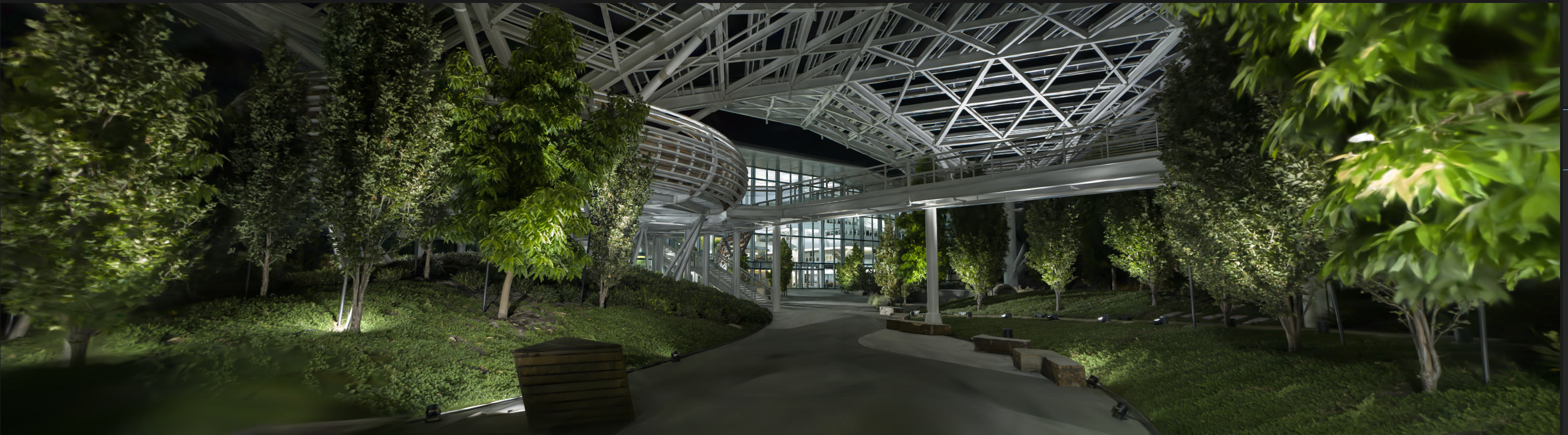
Radiance field environment used for CES keynote

Case Study · Radiance Fields

Building radiance fields for Jensen Huang’s CES keynote

From a blank page to fully lit, production-ready environments that could withstand 8K scrutiny on a 108’ × 29’ LED wall. Designed, built, and delivered by Visual Movement.

Background

Cinematography, radiance fields, and an 8K wall

This project started exactly where Visual Movement is most comfortable: with a blank piece of paper and a difficult ask.

NVIDIA needed environments for Jensen Huang’s CES keynote that felt real, held up cinematically, and could withstand a global audience seeing every pixel on a 108’ × 29’ high, ultra-high-resolution LED wall.

At the time, Gaussian splatting and radiance fields were still emerging in production work. Fidelity, parallax, and performance at this scale were all open questions. Our role was to say: “Yes, this is possible, and here’s how.”

Project at a glance

  • Screen: 108’ × 29’ LED, effectively 8K
  • Medium: Radiance fields / Gaussian splats
  • Use: Live keynote with global audience
  • Owner: NVIDIA & Radiance Fields
  • Role: Visual Movement: design, capture strategy, model build, lighting & delivery

Approach

Treating the radiance field like a set, not a software demo

Inventing the path

When we started, there was no standard playbook for using Gaussian splats at this fidelity and scale. Visual Movement designed the capture strategy, data flows, and model build pipeline from scratch, pushing what was possible technically while staying rooted in filmmaking logic.

Cinematographer-led lighting

Rather than treating the radiance field like a static 3D export, we treated it like a physical location. Working with a film crew from Los Angeles, Lee designed the lighting as if we were on a night exterior set, shaping depth, contrast, and focus to read beautifully on camera and in-room.

In-house model build

Visual Movement built the environments using in-house systems and infrastructure, tuned specifically for radiance fields. The goal was simple: the image had to hold up anywhere it was paused. No shortcuts, no “good enough for stage” compromises.

Delivery

Built to withstand the world’s scrutiny

The radiance fields were designed to be more than background graphics. They had to behave like real locations when cameras moved, when lenses changed, and when editorial decisions were made late in the process.

We validated the environments on reference monitors and directly against the 108’ × 29’ LED wall, checking not just for “wow” moments but for weaknesses: edges, highlights, subtle banding, and places where the illusion might break.

By the time Jensen walked onto the keynote stage, the environments had already been stress-tested from a cinematographer’s point of view. The result: radiance fields that felt grounded, dimensional, and unapologetically real, even to other filmmakers watching at home.
“Our job was to make the technology disappear. What people should notice is the feeling of the place, not the fact it was built from radiance fields.”

Visual Movement
Read more on RadianceFields.com

Thinking about radiance fields or Gaussian splats for your stage?

Visual Movement helps studios, stages, and companies design pipelines where radiance fields, virtual production, and cinematography work together instead of fighting each other.

Contact Visual Movement on LinkedIn